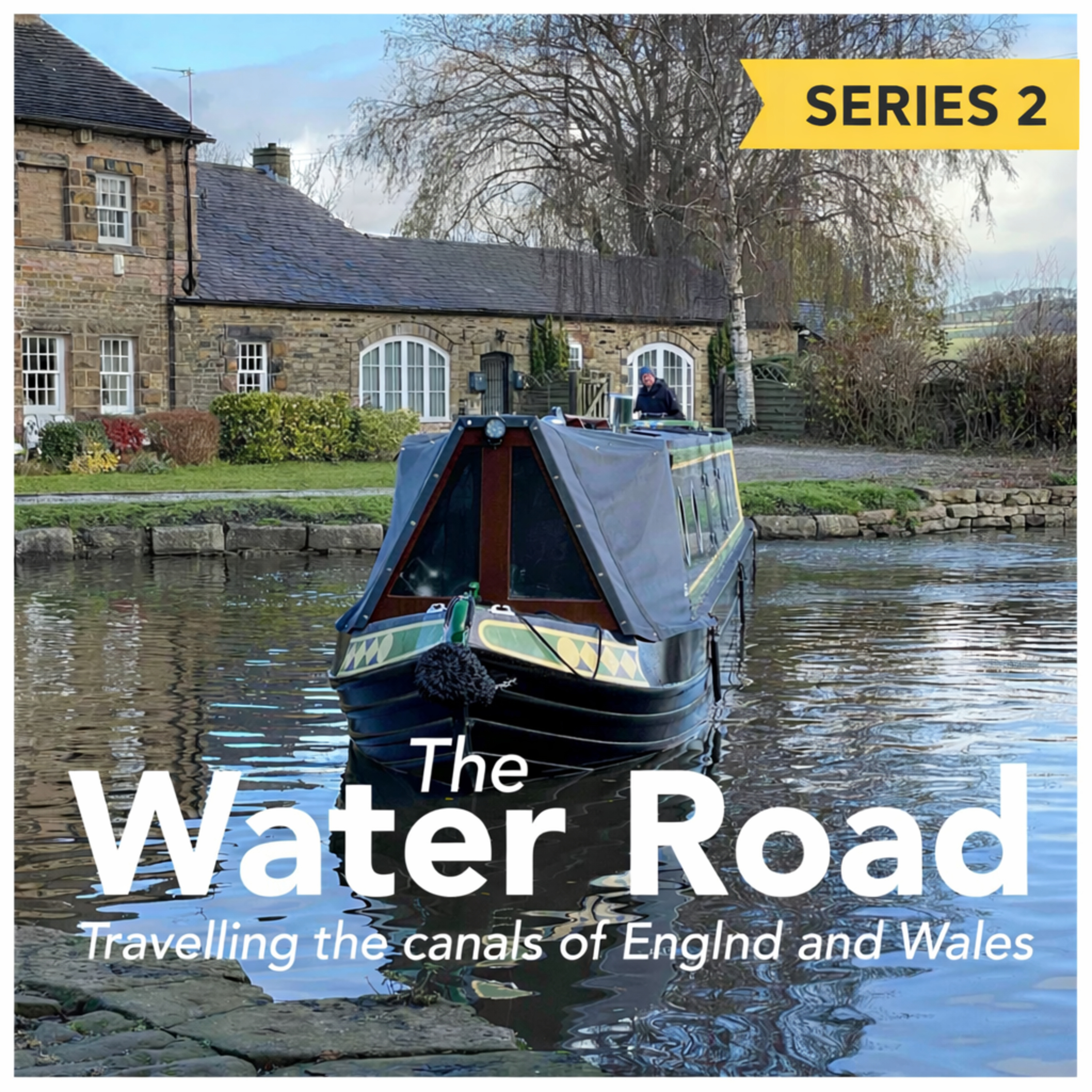
St Richard's Canal Festival, Droitwich
The Story
We're in Droitwich for the St Richard's Canal Festival, an event which has it's roots in the restoration of the Droitwich Canals. We hear from the organiser about it's history and the canal society behind it, learn about the historic boat, Bramble, talk to exhibitors and stall holders, and the trust which operates the community boat, Pamela May 2. And the whole event concludes with the annual duck race on the River Salwarpe.
Click the links for more information on St Richard's Festival; the Worcester, Birmingham and Droitwich Canals Society; Stourport Forward; Little Radford Model Boat Club; and Rosie Philpott.
The Water Road is produced and presented by Adam Porter.
If you enjoy what I do, consider supporting me on Ko-fi! https://ko-fi.com/thewaterroad
We're in Droitwich in Worcestershire, it's the early May bank holiday weekend and it's the Saint Richard's Canal Festival organised by the Worcester, Birmingham and Droitwich Canal Society. Welcome to this edition of the Water Rd. Vines Park in Droitwich has the canal running down one side and the River Salwarp on the other, and for this festival, the area in between is transformed into a lively show site. There's a big marquee and beer tent in the middle where there's music in the afternoons and evenings.
There are stalls for charities and traders, food trucks and an ice cream van. There are fun fair rides. And there are boats. The local community boat, Pamela May, too, is running boat trips, and we'll hear from them later. And there are some historic boats. The festival has its roots in the restoration of the Droitwich canals. They were abandoned in the 1930s and restored by volunteers, reopening in 2011. The main organiser is David Wheeler from the Worcester, Birmingham and Droitwich Canal Society and I spoke to him in the sunshine outside the beer tent.
It all started back in 2011. I was a director of Droitwich Canal Trust for about 18 years, restoring the two canals. The canal from the other side of Vines Park is called the Droitwich Junction Canal, which which joins the Worcester Birmingham Canal down to the Droitwich Barge Canal, which is the one behind us. And the Barge Canal goes down to the River Severn. And in 2011 we actually restored the canals from the Worcester, Birmingham right the way through to the River Severn. So we had a festival here to celebrate the opening.
Because that was quite a remarkable restoration, wasn't it? I mean really successful. Restoration yeah, well, we're really lucky because we actually owned the Droitwich Waterways Trust actually owned the the whole line of the of the canal apart from a bit on the junction canal where one of the old locks was in somebody's garden. So we we had to build a new lock. But other than that, yet it was a major achievement really all done by volunteers. How is that your? Phone. In 2011 we had the celebration ceremony here where we had about 120 votes turned up to celebrate the opening because it was something special to the to the inland waterways movement.
And in 2012 I had a phone call from the managing director, who was then the managing director of Which Haven District Council, to say would we be interested in organising another festival year on. So I went to have a chat to him and realised that they had a St Richard's festival, but it was only on the Saturday of the main bank holiday. And I sort of looked at it and thought, well that's a bit daft really, to have a festival just for one day on a main bank holiday. So I agreed that we would organise one over the three days.
And that was in 2012. And here we are in 2026, still working our socks off to to put a festival on. And that that's really how it's happened. And it's slowly but surely we've built a team of volunteers up that basically they just turn up on the Tuesday and everything starts to assemble it. It's good. Because it's all done by the the Worcester, Birmingham and Droitwich Canal societies. So I mean, it's all volunteers, isn't it? Everything, everything that you see is is organised and run totally by volunteers who give their time totally free of charge.
They get nothing if they're working all day. Obviously we give them some food vouchers so they can go and get some food. So we do feed them. But yeah, it's, it's all done for the benefit of the residents of Droitwe Spa and it it, it seems to work. And tell me a bit about the Canal Society, because that's obviously much bigger than just the the festival, isn't it? It is. We now own the boat called Cecilia, which we use as a community boat where we get quite a number of groups now where we can take them out on day trips and things like that.
And we'll probably one of the smallest in terms of membership canal societies in the country, but we're probably one of the biggest in terms of what we achieve and what we do.
Droitwich is a salt producing town. It's one of the reasons the canal came here. Vines Park contains one of the brine springs, and St Richard gained legendary status when he got it flowing again. Each year his Blessing of the Well is reenacted. We remember all that we value about this community that we're part of. I proclaim this moral blessed. Let us proceed. In peace. Amen. Have a wonderful weekend and God bless you. Well, my normal identity is the Reverend Laura Handy. So Laura, the one of the vicars in Droitwich.
But today you're playing St Richard, really, aren't you? I am. I've inherited a long tradition and joined in with it of the local vicar dressing up as St Richard to re enact the events of today. So just tell me a bit about Saint Richard then, because he's an important person round here, isn't he? He is indeed. He was born and bred in Droitwich, but is most known for being the Bishop of Chichester. Many Droitwich folks will be more familiar with St Richard's Hospice and may not know that that was started by folks in Droitwich who took the inspiration from Saint Richard.
So he was a local lad who grew up and found himself working hard in on the family farm and to try and ensure during tough times they had what they needed. He delayed education to do that, but then found himself in a position as a Bishop, having been ordained. And when the salt springs had all dried up and the town was going to be in crisis with the salt industry, people looked to him. And rather than look away, thankfully he helped people have the confidence and courage to clear everything out. And then he had the privilege of praying a blessing on the well.
And when those waters flowed again for the salt industry and for all the families who depended on it, it gave fresh hope. Which means salt, doesn't it? So that's why it's Droitwich. So it's, it's, it's absolutely crucial. Yeah, absolutely. And there's so many things in our history the the newly renovated heritage centre captures brilliantly the the salt history. So if anyone hasn't visited that in Saint Richard's house, there's the link again that tells of the significance to the population at the time and actually the community that that grew around it that we're that we're part of today and.
The well here you've just re blessed is is the sort of living embodiment of it. It is indeed, and it's preserved. It's got the big, the big gates around it now, but it's captures the history in a little information board. But absolutely it was the place where that town gathered. And of course the the salt barges would would take the salt to where it needed to go. And the the conical kind of salt container meant you knew it came from Droitwich. Sir Richard himself got his statue just the other side of the park.
Just a reminder, I think of that this has been always a community that's had to work hard, that's had to work together, that the times when working hard and together has gone well. I mean, it has led to a future, the times when people have pulled apart from each other. And, and perhaps in these times in which we're living, re enacting a, in many ways a bit of an absurd tradition of me prancing around bed dressed as a Bishop. It's just an opportunity for us to kind of look back and maybe go actually, even when there's hard times, pulling together as a community helps us find our way.
So now I'm on board Bramble, which is one of the historic boats here, and with Eliza I'm. A volunteer with Stanford Forward. So just tell me a bit about the history of the boat then. OK, well, we're sitting inside the cabin of working boat Bramble, and she was built for Fellows Morton and Clayton in 1934. Fellows Morton and Clayton was a carrier and they carried mainly coal and steel bars between Birmingham and London, sort of going up and down the Grand Union Canal. And at that time people lived in the cabin.
So Emma and Albert Russon were the captain and his wife the best mate, and they lived on the boat, but they also had a booty boat that they towed behind Bramble. So you've got the cabin set up as it would have been. I mean, there's not much room in here. Is there no absolutely when you think a family would live in this space? So we've got a bed. It's a very small bed actually. I don't need volunteer to do this. If you were tall, it's supposed to be a double bed for the captain and his wife. And then they have, they've got the other boat as well or they did have.
So they would have two cabins. So the mate there wasn't mate went with them. He probably was in the other one. But in here we've got everything in the cupboard. So everything there's a, there's a sort of saying that says everything in its place and a place for everything. And it really is true, isn't it? On a narrow boat. This is tiny. So when you pull the cupboard door off your little food cupboard, the table comes down. That makes you table. It's always in the way. If you try and eat in here, when the boat's moving and you try and put the table down, it's a nuisance because people are trying to squeeze past it.
There's a door to the engine room just on that side. There's a little window out to the engine room that you can pull across, but you have to put the bed up every day. And then next to you there's this stove, which we haven't got on today. But if you want hot water, you want to cook anything, you've got to light the stove and it's really warm. So tell me about the boat today then, what's it? Because it's based in Stourport. Isn't it? Yes, it is. Yeah. So it was restored by a man called Richard Brindley back in about 2002 and then eventually it came to Starport Forward.
So it was owned by what used to be British Waterways. They sold it to Starport Forward for a pound. But I think Star put Forward probably didn't realise the amount of work is that's involved in restoring A historic boat. So we work with a boat builder, a really good historic boat builder called Martin Brooks. He restored the engine for us. He and Joe Hollingshead and all boatmen got the stove and the engine going again and amazing. It was awesome. Seized up and they filled it full of oil and then drained the oil out and it worked.
Incredible. So we've had quite a lot done to it over the last few years. So probably in the last 10 years we've been doing a lot more work to make it more accessible and we've been able to come to Droitwich, which is fabulous. And the hold, of course is a is a big open space. What do you use that for? Well today we've got it as a boat cinema, so people can come and see historic films. So we've got a few films that we've allowed to show, which is great. And we've got a film about the Unlocking the Severn project in Diggless as well, which is all about the fish swimming up the River Severn.
So that's great. But we also use it for we do Santa's grotto on the boat at Christmas. We do lots of boat trips because we were a registered trip boat, so we can only take 12 people at a time and it's a very rustic experience because you've got no toilets, you've got no facilities. But we stop at a pub so it's all lovely.
So with Gareth on your stall and you're a painter, you do the roses. That's it yes, I've been doing it for a few years now just a hobby really. The painting itself. I tried to study historic painters such as like the Bronston painters and also the painters from like the northern style of Roses from like the pottery. So just try to keep my painting as traditional as we can. Because they look really simple, the roses, the canal roses, don't they? But they're more complicated than they. That's right.
I mean from a quick glance at the roses, it doesn't look a lot to them. The trick is there is a lot of layers which you build up. But obviously years ago when the boats were actually working, the idea was to put the flowers on as quick as you can, make them look pretty and get the boats moving because obviously whilst they were all sat up they were earning no money. It's possible to tell who's painted particular roses. Isn't it of your own style? So. I'm quite a new painter as such, so really I suppose I have got my own style.
But yes, certainly if you look at painters from the past you can certainly tell who did them and and who's influenced them as well. So everyone is usually influenced by a certain painter.
So one of the most eye-catching stands in the festival, I think is, is the Little Bradford Model Boat Club. And John, you're the chairman. Just tell me a bit about the club. Well, we started the club almost 19 years ago, we constructed our own clubhouse. Now we've got 4 facilities, we've got hot and cold running water, we've got everything we want really. And then you bring your boats to things like this. I mean, there's an amazing variety of boats up on the stand there, isn't there? Oh yes, well I've been building since lighting, I'm doing 60 so I've done a bit, but the members, they're all modellers as well and they're all dead keen at the present moment.
There's twenty of us in the club and as you've seen, we do produce quite a nice display. And you've got one of your boats out on the canal at the moment. Tell me about that one. Oh, that there. That's Angie. Angie's a kit boat produced by a company called Crick, but a very, very popular boat with the younger modellers because it's a fibreglass shell and wooden construction. Some of the lighter kits now are all plastic. And it's not quite, no not quite so nice to handle plastic as. Plywood and Angie's a fishing boat and you've just encountered some Swans.
Yes, but one lesson you do learn with boats is don't mess with Swans. They don't like boats for some strange reason. Excuse me. Oh, it's all right. I just got it back. You all right? I've lost sight and the Swans are actually bigger than the boats, aren't they? Well, the Swans are bigger than the boats and when they've got youngsters they're very protective.
Another of the stands here is Rosie Philpott and you're an artist based in Droitwich. Droitwich seems to be quite a a painty place. It's it's all the wonky buildings and everything, isn't it? Yes, so my artwork is watercolours of local views and they're all in a quirky, wonky style, so I call it wonky art. And Droitwich High Street is just been rebranded the Wonky St on Northern new signage as well, which was inspired by my work apparently, so that's great. Yes, all my paintings are just a bit different, different perspectives of the town and local area.
We should say the reason that Droitwich is wonky is because of all the brine extraction. Isn't it? Yes. So that's what inspired the first painting I did about 15 years ago of the High Street called Wonky Droitwich. And obviously, yes, the buildings are wonky because of the subsidence due to the salt extraction. So I exaggerated the style and people really liked it. So I've carried it on throughout all my work. How big an event is this festival for you then? The pain events I do, so I do three of the local festivals in Droitwich and I get a lot, a lot of work from here and it's a great festival to do, It's really well supported and it's just great to be involved in town events.
And have you painted the canal? I have. I've got a few paintings actually. I've done 1 based in here in Vines Park, and I've got the community canal boats and I've also done one further up the Eagle and Sun. That's in Hungary. Yeah. And those paintings seem to be popular with people. There are two swing bridges over the canal in Vines Park, and each time the trip boat comes along, which is many times in a day, some of their volunteers have to swing the bridges out of the way.
First of all, there is the Pamela May 1 which was a traditional engine. Pamela May 2 now is all electric and it proves to be very successful. People enjoy it along the canal stretches here that we operate on. We because of the the number of winding holes. Our maximum length of boat is 50 feet, so that's a bit of a restriction, but we take up to 12 passengers. That's our licence number. So David, what sort of trips are you doing then what? What sort of people are coming on the boat? Well, we promote it amongst the various care homes, social organisations and a few private parties because that helps to defray some of our costs.
We also have bridal parties. We've taken a party down to the Church of Salwar that's normally a 2 hour trip. Took a little longer on that occasion but we also took a bridal party down towards Worcester as well on one occasion. So it's really introducing people to the waterways who who might not otherwise know much about. Them. Well, very much so, yes. I think for the elderly and the more infirm groups, we've got a lift so we can offer the trips to those who are less able or in wheelchairs and it just gets them out of their normal sort of four walls situation and they thoroughly enjoy it.
They just come out and have a good Nat of and we do cream tea trips which are very popular. We do fish and chip trips which are equally popular, but primarily we do 2 hour trips, three hour, 5 hour and 8 hours. And the canal and your boat are a fantastic resource for the town, aren't they? Well, very much so. I think we're undervalued at times, but people are getting to know us more now.
The festival here in Droit, which has traditionally ended with a duck race with about 1500 plastic doves racing down another soldier and. A few going round in circles. 497 lost the leader we. Have a winner. All the adjudicators trying to get through the cow crowd to find out 452 was the winner. 45. 2.
And the duck race brings to an end this bumper edition of the Water Rd from the Saint Richard's Canal Festival in Droitwich. The podcast is produced and presented by me, Adam Porter. Don't forget, if you haven't already followed or subscribed, please click that button and then you'll be alerted when future episodes are released. And don't forget also that every previous episode is always available to listen to. Thank you for listening to The Water Rd.
 Apple Podcasts
 Castbox
 Castro
 Goodpods
 Moon FM
 Overcast
 Pocket Casts
 Podbean
 Podcast Addict
 Podcast Republic
 Spotify